Back

Blue Team Certified – Defensive Security

The Certified Cybercop Blue Team program is designed to teach and evaluate real defensive security abilities across a wide variety of blue-team disciplines, making it ideal for newcomers to the sector as well as seasoned security professionals.

Level: Intermediate to Advanced
Duration: 5 Days (Instructor-Led)
Exam: 90 Multiple Choice, 180 Minutes 70%

Course Overview

The Certified Cybercop Blue Team – Defensive Security program is designed to equip individuals with the skills and knowledge needed to defend organizational IT infrastructures and respond effectively to cybersecurity threats. Participants learn critical concepts, including incident response and handling, where they develop and execute plans to identify, analyze, and mitigate security incidents. The program emphasizes security monitoring and threat detection using tools like SIEM to analyze anomalies and threat intelligence. It covers vulnerability management, focusing on assessing risks, applying patches, and prioritizing vulnerabilities. Key network defense strategies such as configuring firewalls, intrusion detection/prevention systems (IDS/IPS), and securing network traffic are integral components. Additionally, participants gain expertise in endpoint security, system hardening, and securing remote devices, along with an understanding of compliance frameworks like NIST, ISO 27001, and GDPR. The curriculum includes forensic analysis and malware investigation to understand the origin and impact of threats, along with strategies to counter advanced threats like APTs and social engineering. This program is ideal for IT professionals, network administrators, and individuals aiming for roles in Security Operations Centers (SOCs), preparing them for certifications like CompTIA CySA+, CEH, or GIAC. By the end of the program, participants are equipped to implement and monitor robust security solutions, respond to cyber threats, and ensure compliance with regulatory standards.

Corporate Training

CertCop offers tailored group training programs designed for organizations, teams, and institutions aiming to build strong cybersecurity capabilities at scale. Our corporate training solutions focus on real-world skills, hands-on learning, and certification readiness, helping teams stay ahead of evolving threats and technologies. With flexible delivery options—including virtual, on-site, and customized programs—we ensure training aligns with your business goals, technical requirements, and workforce development needs.


What you’ll learn

  • Incident Response & Handling – Learn how to identify, analyze, and respond to cybersecurity incidents effectively
  • Security Monitoring & Threat Detection – Use tools like SIEM to detect anomalies and potential attacks
  • Vulnerability Management – Identify weaknesses, prioritize risks, and apply remediation strategies
  • Network Defense Techniques – Configure firewalls, IDS/IPS, and secure network traffic
  • Endpoint & System Security – Protect devices through hardening and secure configurations
  • Digital Forensics Basics – Investigate security breaches and analyze evidence
  • Threat Intelligence & Analysis – Understand attacker behavior and emerging threats
  • Security Tools & Automation (SOAR) – Use automation to improve response efficiency
  • Identity & Access Management (IAM) – Secure user access and authentication systems
  • Compliance & Security Frameworks – Learn standards like NIST, ISO 27001, and GDPR

Key Skills You Will Gain

  • Blue Team Methodology: Mastering defensive security roles, goals, and metrics while distinguishing red and blue team functions.
  • Recruiting Blue Team Members: Identifying technical, soft, and leadership skills for building effective blue teams.
  • Intro to Linux: Using Linux basics, commands, and architecture for security operations.
  • Linux File System: Managing file structures, permissions, and commands in Linux.
  • Linux Package Management: Administering software packages using RPM, YUM, and APT tools.
  • Bash and Tools: Writing bash scripts and leveraging Linux tools for automation.
  • Linux Services: Controlling and securing system services with systemd.
  • Linux Firewall: Configuring firewalls using iptables and firewalld for network security.
  • Identity and Access Management: Implementing user authentication and access control strategies.
  • Threat and Vulnerability Management: Assessing and mitigating threats and vulnerabilities with tools.
  • Policies and Procedures: Developing and enforcing security policies and compliance measures.
  • Security Information and Event Management: Managing logs and correlating events with SIEM tools.
  • Security Orchestration Automation and Response: Automating and responding to incidents using SOAR workflows.
  • Incident Response: Planning, detecting, and recovering from security incidents.
  • Digital Forensics: Collecting and analyzing digital evidence while maintaining chain of custody.
  • Vulnerability Scanning: Conducting and interpreting scans with vulnerability tools.
  • Web Application Security: Identifying and mitigating common web vulnerabilities.
  • Secure Software Development: Applying secure coding and testing in development lifecycles.
  • Cryptography: Utilizing encryption, key management, and cryptographic protocols.
  • Public Key Infrastructure: Managing digital certificates and PKI components for secure communication.

Career Outcomes

  • Security Analyst – Monitors networks, detects threats, and responds to incidents.

  • SOC Analyst (Security Operations Center Analyst) – Works in a SOC to detect and respond to security incidents.

  • Incident Responder – Investigates security breaches and takes steps to mitigate attacks.

  • Threat Intelligence Analyst – Gathers and analyzes threat data to improve security posture.

  • Vulnerability Analyst – Identifies and assesses security vulnerabilities in systems.

  • Cybersecurity Engineer – Designs and implements security systems and defenses.

  • Digital Forensics Analyst – Investigates cybercrimes, collecting and analyzing digital evidence.

  • Penetration Tester (Defensive Security) – Tests security controls and defenses to strengthen security.

  • Security Architect – Designs secure IT systems and network infrastructures.

  • Compliance and Risk Analyst – Ensures security policies meet industry and government regulations.

Exam Details

Course NameCertified CyberCop – Blue Team
Course Number:CertCopBT01
Required examCCBT-E002
Number of QuestionsMaximum of 90 questions
Type of QuestionsMultiple-choice and performance-based
Length of Test180 Minutes
Passing Score 70% – This test has no scaled score; it’s pass/fail only.
RetirementUsually three years after launch
LanguagesEnglish

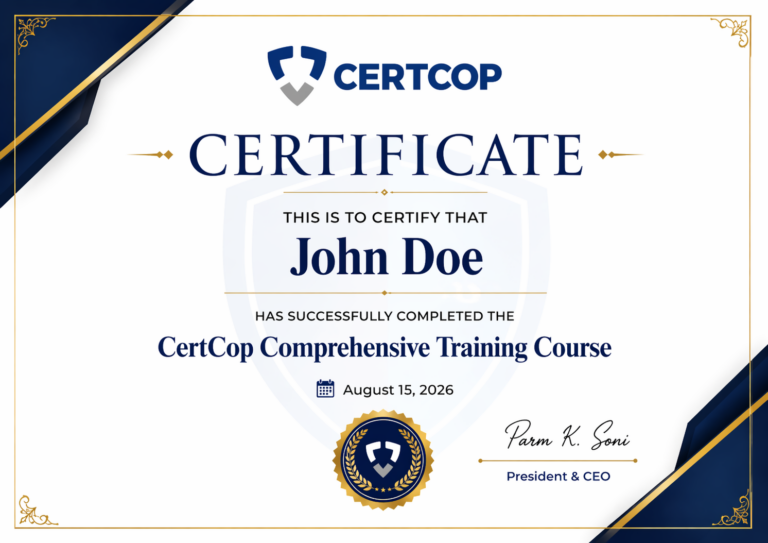
Sample certificate

Training Options

Whether you’re looking for in-classroom or live online training, CertCop offers best-in-class instructor-led training for both individuals and teams. You can also find training among CertCop’s vast network of Authorized Training Partners.

On-Demand Training

Virtual Live Training

Class Room Training

Hybrid Training

Group Training

Related Certifications