

Certified Biometric Security Developer (CBSD) Certified Biometric Security Developer –...
Read MoreCertified Biometrics and Artificial Intelligence(CBAI)
The “Biometrics and AI” course trains IT and security professionals in biometric technologies and their AI integration for secure identity management. It covers biometric modalities (e.g., fingerprints, facial recognition), their evolution, and applications in industries like banking and healthcare. The curriculum emphasizes biocertification’s role in ensuring expertise, compliance with standards (e.g., ISO, NIST), and addressing privacy concerns. Learners explore AI tools like TensorFlow and SDKs (e.g., MegaMatcher) to enhance system accuracy and security against spoofing. Through practical exercises and case studies, the course prepares participants for advanced biometric implementations and emerging trends like multimodal systems and federated learning.

Level: Intermediate to Advanced
Duration: 5 Days (Instructor-Led)
Exam: 60 Multiple Choice,90 Minutes 70%
Course Overview
The “Biometrics and AI” course offers an in-depth exploration of biometric technologies and their integration with artificial intelligence (AI) to enhance secure identity management systems. Designed for IT and security professionals, the course covers the fundamentals of biometrics, including key modalities such as fingerprints, iris scans, facial recognition, voice recognition, and behavioral biometrics like keystroke dynamics. It emphasizes the historical evolution of biometrics, its transition from traditional authentication methods, and its real-world applications across industries like banking, healthcare, government, and defense. The curriculum also delves into the critical role of biocertification in validating expertise, ensuring compliance with international standards (e.g., ISO, NIST), and addressing privacy and security concerns. With a focus on practical skills, the course equips learners to design, implement, and troubleshoot biometric systems while fostering trust and reliability in their deployments.
A significant component of the course is its emphasis on AI’s transformative impact on biometrics, explored through topics like multimodal biometrics, AI-driven liveness detection, and decentralized systems using technologies such as blockchain and federated learning. Learners are introduced to advanced AI tools and techniques, including machine learning frameworks (e.g., TensorFlow, PyTorch) and specialized biometric SDKs (e.g., Neurotechnology MegaMatcher, Cognitec FaceVACS), which enhance system accuracy, speed, and resilience against spoofing attacks. The course also addresses emerging trends like Explainable AI (XAI) for transparency and the integration of biometrics with IoT and wearable devices, preparing professionals for future challenges. Through hands-on exercises, case studies (e.g., airport security, mobile device protection), and review questions, participants gain a structured approach to mastering biometric systems, optimizing performance (e.g., reducing FAR/FRR), and ensuring ethical, privacy-focused implementations in a rapidly evolving technological landscape.
Corporate Training
CertCop offers tailored group training programs designed for organizations, teams, and institutions aiming to build strong cybersecurity capabilities at scale. Our corporate training solutions focus on real-world skills, hands-on learning, and certification readiness, helping teams stay ahead of evolving threats and technologies. With flexible delivery options—including virtual, on-site, and customized programs—we ensure training aligns with your business goals, technical requirements, and workforce development needs.
On-Demand Training
Virtual Live Training
Class Room Training
Hybrid Training
Group Training
Key Features
✅ Comprehensive Curriculum
Covers core and advanced concepts of biometric security, including modalities, architecture, and encryption.🧠 Hands-on Training
Includes practical labs and exercises to implement and test biometric systems in real-time environments.🌐 Industry-Relevant Content
Aligned with current industry standards like ISO/IEC and regulatory frameworks such as GDPR.💼 Career-Focused Learning
Prepares you for real-world job roles in biometric and cybersecurity domains.🎓 Globally Recognized Certification
Earn a respected credential that validates your expertise in biometric security.
🔐 Security-Centric Approach
Emphasis on biometric data protection, anti-spoofing methods, and system hardening.🛠️ Tool and SDK Exposure
Introduces popular biometric development tools and SDKs for face, fingerprint, and iris recognition.📊 Performance Evaluation Techniques
Learn how to assess biometric systems using metrics like FAR, FRR, and EER.👨🏫 Expert Instructor Support
Get guidance from certified instructors with industry and teaching experience.⏱️ Flexible Learning Options
Available in self-paced, instructor-led, and hybrid formats to suit your schedule.
Learning Path
- Introduction to Biometrics and Biocertification
- Definition and importance of biocertification
- Role in secure identity management systems
- Historical Evolution of Biometrics
- Ancient practices to modern advancements
- Transition from traditional authentication to biometric solutions
- Biometric Modalities
- Overview of fingerprints, iris scans, facial recognition, voice recognition, and behavioral biometrics
- Strengths and challenges of each modality
- Applications of Biometrics
- Real-world use cases in banking, healthcare, government, defense, and more
- Role in identity verification, access control, and fraud prevention
- The Need for Biocertification
- Rising demand for qualified professionals
- Validating skills, knowledge, and adherence to industry standards
- Benefits of Biocertification
- Enhancing career prospects
- Building trust and supporting regulatory compliance
- Standards and Compliance
- Importance of international standards (ISO, NIST)
- Role of certifications in interoperability and security
- Emerging Trends in Biometrics
- Multimodal biometrics, AI integration, decentralized systems
- Evolution of biocertification with technological advancements
- Challenges in Biocertification
- Addressing misconceptions and privacy concerns
- Keeping certifications updated with emerging technologies
- Introduction to Artificial Intelligence (AI)
- Definition, scope, and key components (e.g., machine learning, neural networks)
- Types of AI
- Narrow AI (Weak AI) and its applications in biometrics
- Potential of General AI
- AI Tools and Techniques in Biometric Security
- Machine learning frameworks (TensorFlow, PyTorch, Keras)
- Specialized biometric SDKs (Neurotechnology MegaMatcher, Cognitec FaceVACS)
- Liveness detection and behavioral biometrics
- AI Algorithms and SDKs in the Market
- Overview of Neurotechnology MegaMatcher, Cognitec FaceVACS, Face++, VeriLook, VeriEye
- Comparison of detection speed, accuracy (FAR/FRR), and security resilience
- Improving Biometric Security with AI
- AI-driven liveness detection (pulse/vein recognition, texture analysis)
- Continuous authentication and anomaly detection
- Template protection and encryption
- AI for Biometrics Testing and Evaluation
- Generating synthetic biometric data (e.g., using GANs)
- AI-driven simulation tools for stress-testing
- AI-Powered Biometric Solutions for Industry Use Cases
- Case studies: Airport security, mobile device protection, financial sector fraud prevention
- Lessons learned and best practices
- Future of Biometrics with AI
- Emerging trends: Federated Learning, Explainable AI (XAI), wearable/IoT integration
- Opportunities and challenges
- Step-by-Step Solutions for Optimizing AI-Based Biometric Systems
- Enhancing accuracy and reducing FAR/FRR
- Implementing liveness detection and encryption
- Real-time anomaly detection
What Skills Will You Learn?
Foundational Knowledge of Biometrics
Understand the core concepts, history, and evolution of biometric systems, including modalities like fingerprints, iris, and facial recognition.Biometric Modality Evaluation
Analyze the strengths, limitations, and appropriate use cases for various biometric techniques such as voice recognition and behavioral biometrics.Application of Biometrics in Real-World Scenarios
Learn to implement biometric systems across industries including finance, healthcare, government, and defense for authentication and fraud prevention.Understanding of Biocertification Standards
Gain knowledge of global standards (ISO, NIST) and their role in biometric system compliance, interoperability, and secure implementation.Integration of AI in Biometric Systems
Apply AI concepts like machine learning and neural networks to enhance biometric accuracy, security, and liveness detection.
Hands-on Experience with AI Tools and SDKs
Work with tools such as TensorFlow, PyTorch, and biometric SDKs like Neurotechnology’s MegaMatcher or Cognitec FaceVACS for real-world implementation.Security and Privacy Enhancements Using AI
Implement techniques like continuous authentication, template protection, and AI-driven anomaly detection to safeguard biometric data.Evaluation and Testing of Biometric Systems
Use AI-based methods to simulate stress-testing, generate synthetic biometric data (e.g., GANs), and evaluate system performance metrics like FAR/FRR.Solution Design for Industry Use Cases
Develop end-to-end AI-powered biometric solutions tailored to specific industry needs, including mobile security, airport screening, and financial fraud prevention.Future-Readiness in Biometric Technology
Stay ahead with emerging trends like Federated Learning, Explainable AI, and wearable/IoT biometric integration to innovate and adapt to future demands.
Career Outcomes
Biometric Systems Analyst
Design, evaluate, and optimize biometric authentication systems for government or enterprise use.AI Security Engineer
Develop and implement AI-driven security protocols, including biometric liveness detection and anomaly detection.Biometric Data Scientist
Analyze biometric data using machine learning models to improve system accuracy and reduce false match rates (FAR/FRR).Identity and Access Management (IAM) Specialist
Integrate biometric systems into identity management solutions for secure user authentication and access control.Cybersecurity Analyst (Biometric Focus)
Monitor and secure biometric authentication infrastructures, ensuring data privacy and regulatory compliance.Machine Learning Engineer (Biometrics)
Build and train AI models using biometric datasets to enhance authentication speed and accuracy.Biometric Product Manager
Lead the development of biometric-based products or solutions for sectors like banking, healthcare, or consumer electronics.AI Researcher in Biometrics
Conduct R&D on new AI methodologies to improve or innovate biometric technologies (e.g., Explainable AI, Federated Learning).Technical Consultant – Biometrics and AI
Advise organizations on how to implement, scale, and secure biometric systems with AI enhancements.Forensic Biometric Analyst
Support law enforcement and forensic investigations by applying biometric and AI techniques for identity verification and analysis.
Exam Details
| Course Name | Certified Biometrics and Artificial Intelligence (CBAI) |
| Course Number: | CBAI |
| Required exam | CBAI-025 |
| Number of Questions | Maximum of 60 questions |
| Type of Questions | Multiple-choice and Scenario-based |
| Length of Test | 90 Minutes |
| Passing Score | 70% – This test has no scaled score; it’s pass/fail only. |
| Retirement | Usually three years after launch |
| Languages | English |
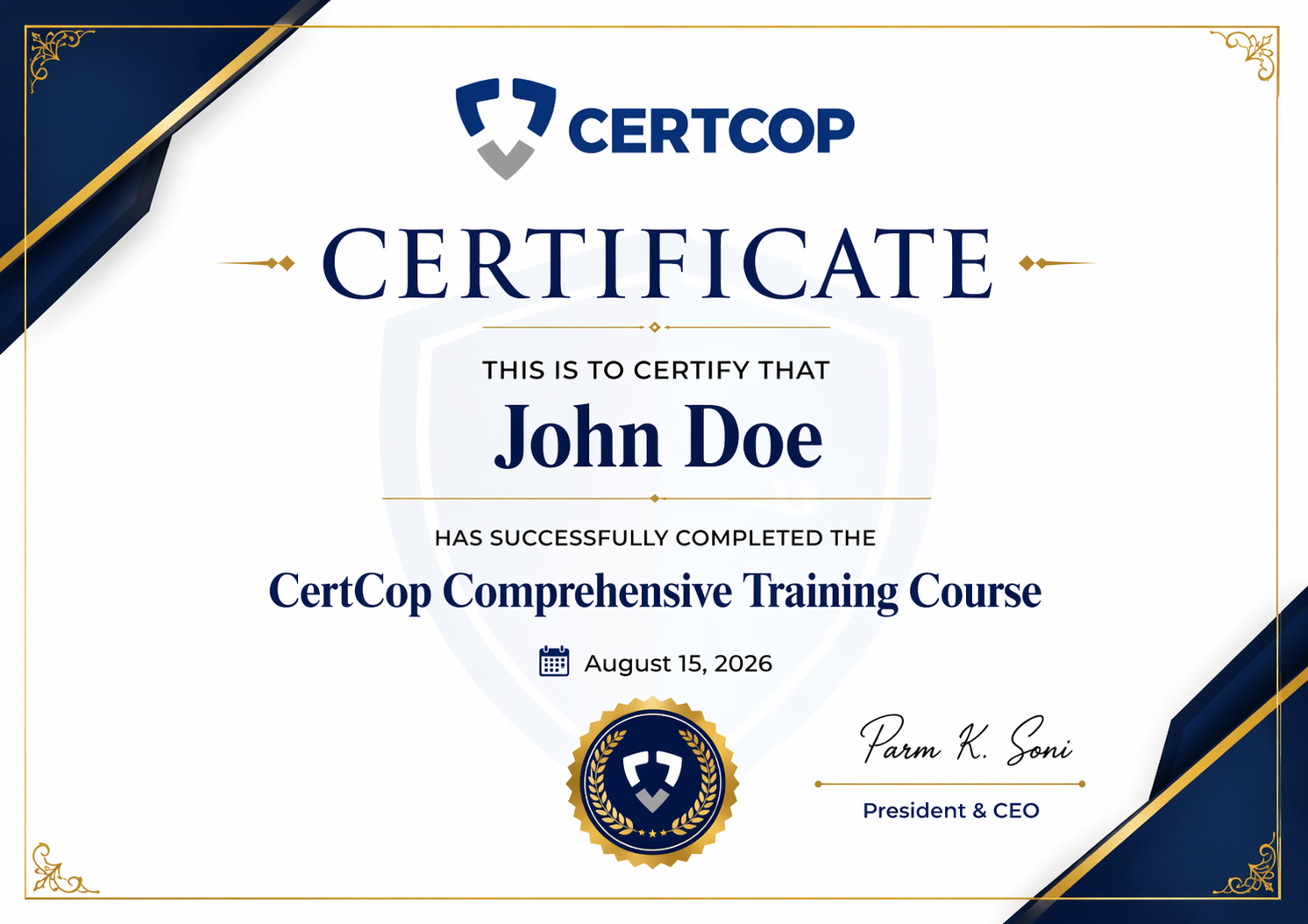
Sample certificate
Training Options
Instructor-Led Training (events)
Whether you’re looking for in-classroom or live online training, CertCop offers best-in-class instructor-led training for both individuals and teams. You can also find training among CertCop’s vast network of Authorized Training Partners.
Register Now:
Related Certifications
Certified Biometric Security Engineer (CBSE)
Certified Biometric Security Engineer(CBSE) CBSE designates knowledgeable technology professionals in...
Read More
Certified Biometric Security Professional (CBSP)
Certified Biometric Security Professional (CBSP) CBSP is a foundation level...
Read More