

CertCop – Certified Cyber Security Engineer Certcop’s Cyber Security Engineer...
Read More
CertCop - Chief AI Security Officer
The CertCop – Chief AI Security Officer program is a cutting-edge executive certification designed for modern security leaders operating at the critical intersection of cybersecurity, artificial intelligence, and biometrics. This 5-day intensive course equips CISOs, security executives, and risk professionals with the leadership acumen, technical depth, and strategic foresight required to govern AI-integrated enterprises in today’s evolving digital threat landscape.
Participants will gain hands-on insights into AI-enabled security operations, biometric system governance, AI/ML threat modeling, compliance with AI-specific regulations (like the EU AI Act), and national security readiness in critical infrastructure environments. The program emphasizes a risk-based, compliance-aligned, and intelligence-driven approach to AI security leadership.
The CAISO curriculum is structured around five core themes—leadership and governance, enterprise security architecture, AI/biometric threat mitigation, national defense readiness, and strategic board-level cybersecurity management.
Level: Intermediate to Advanced
Duration: 5 Days (Instructor-Led)
Exam: 90 Multiple Choice, 180 Minutes 70%
Course Overview
The CertCop – Chief AI Security Officer certification is a groundbreaking 5-day executive education program designed to empower cybersecurity leaders at the intersection of AI, biometrics, and enterprise security governance. As organizations adopt artificial intelligence and machine learning at scale, traditional security roles must evolve. The CAISO program delivers the strategic, technical, and regulatory expertise needed to lead in this AI-driven era.
Through a blend of instructor-led training, executive worksheets, real-world case studies, and scenario-based assessments, participants gain deep insight into AI security risks, biometric integration, cloud and Zero Trust architecture, legal obligations, and national security readiness.
Whether you are a CISO, security architect, or AI/ML leader, this course will elevate your ability to align cutting-edge technologies with robust cybersecurity frameworks and boardroom-level governance.
Corporate Training
CertCop offers tailored group training programs designed for organizations, teams, and institutions aiming to build strong cybersecurity capabilities at scale. Our corporate training solutions focus on real-world skills, hands-on learning, and certification readiness, helping teams stay ahead of evolving threats and technologies. With flexible delivery options—including virtual, on-site, and customized programs—we ensure training aligns with your business goals, technical requirements, and workforce development needs.
Training Options
Whether you’re looking for in-classroom or live online training, CertCop offers best-in-class instructor-led training for both individuals and teams. You can also find training among CertCop’s vast network of Authorized Training Partners.
On-Demand Training
Virtual Live Training
Class Room Training
Hybrid Training
Group Training
Key Features
1. AI-Centric Cybersecurity Leadership Training
Prepares CISOs and security executives to lead in environments where AI is deeply embedded in cybersecurity operations, decision-making, and governance.
2. Integrated AI Risk Management Frameworks
Covers AI-specific frameworks like NIST AI RMF, ISO/IEC 23894, and EU AI Act, enabling leaders to govern AI responsibly across global regulatory landscapes.
3. Zero Trust and Cloud-Native Architecture with AI Enhancements
Equips participants to build Zero Trust architectures, secure multi-cloud environments (AWS, Azure, GCP), and apply AI for dynamic access control and threat detection.
4. Secure the Entire AI Lifecycle (MLSecOps)
Focuses on the secure development, deployment, and monitoring of AI models, including protecting training data, securing APIs, and defending against adversarial inputs.
5. AI-Augmented Threat Intelligence and Incident Response
Teaches how to implement AI-driven SOAR, UEBA, and behavioral analytics for faster and more accurate threat detection, response, and forensics.
6. Governance of Biometrics and Critical Infrastructure
Addresses governance and protection of biometric identity systems, liveness detection, and AI-driven physical and national infrastructure, including smart grids and drones.
7. AI Ethics, Bias Mitigation, and Explainability (XAI)
Provides tools to ensure fairness and transparency in AI, reduce algorithmic bias, and comply with privacy regulations (e.g., GDPR’s “right to explanation”).
8. Boardroom-Level Communication and Executive Reporting
Develops the ability to translate complex AI risks into business terms, build dynamic dashboards, and align cybersecurity metrics (MTTD, MTTR, KRIs) with strategic goals.
9. Legal and Compliance Readiness for AI Systems
Covers AI-related breach notification laws, contract clauses for AI vendors, and automated compliance audits, addressing the legal realities of operating AI systems.
10. Scenario-Based, Executive-Level Certification
Concludes with real-world case simulations on AI failures, biometric breaches, and leadership crises—ensuring candidates are exam-ready and boardroom-ready.
Learning Path
Domain 1: CISO Leadership & Strategic Governance
Domain 2: Enterprise Security Architecture & Emerging Technologies
Domain 3: Risk, Threat Intelligence & Incident Response
Domain 4: AI Security, Biometrics & National Security Readiness
Domain 5: Governance, Cyber Budgeting, Legal & Boardroom Strategy
What Skills Will You Learn?
🔐 1. Lead AI-Driven Cybersecurity Programs
Develop and manage enterprise-wide cybersecurity strategies that incorporate AI, Zero Trust, and cloud-native architectures.
📊 2. Translate AI Security Risks for the Boardroom
Communicate AI-related risks using business-aligned metrics and dashboards (MTTD, MTTR, KPIs, KRIs) for executive and board-level stakeholders.
📦 3. Design Secure AI & Machine Learning Pipelines
Apply MLSecOps principles to secure data pipelines, model training, deployment environments, and defend against AI-specific threats like adversarial inputs and model inversion.
🌐 4. Implement AI-Enhanced Enterprise Security Architecture
Build layered, scalable architectures aligned with frameworks like TOGAF, SABSA, and Zero Trust—augmented by AI-based threat modeling and monitoring.
🧠 5. Govern AI Risk and Ethical Use of Algorithms
Identify and mitigate algorithmic bias, promote AI explainability (XAI), and align AI systems with frameworks like NIST AI RMF and the EU AI Act.
🧾 6. Master Regulatory Compliance for AI and Privacy
Navigate global regulations (GDPR, HIPAA, PCI DSS, CCPA, EU AI Act), and build unified compliance and audit-readiness programs for AI systems.
👁️ 7. Secure and Govern Biometric Identity Systems
Design, deploy, and monitor biometric access controls using AI-enhanced liveness detection and anti-spoofing measures while ensuring legal compliance (e.g., BIPA, GDPR).
⚔️ 8. Leverage AI in Threat Intelligence & Incident Response
Deploy AI-based SOAR platforms, behavioral analytics, and adversary simulation to accelerate detection, triage, and recovery from both traditional and AI-generated threats.
🤝 9. Manage Third-Party and AI Vendor Risks
Assess third-party AI providers for bias, data handling practices, model transparency, and include AI-specific clauses in contracts and risk scoring models.
📉 10. Optimize Cybersecurity Budgeting with AI Insights
Justify cybersecurity and AI investments using ROI, risk reduction models, and AI-assisted budgeting tools for strategic allocation of resources.
Career Outcomes
1. Chief AI Security Officer
Lead enterprise AI risk strategy, governance frameworks, and incident response across AI-integrated environments and critical infrastructure.
2. Chief Information Security Officer (CISO)
Elevate your CISO role with deep AI, biometrics, and machine learning security capabilities to stay ahead of emerging threats and compliance mandates.
3. Director of AI/ML Security
Own the development and enforcement of AI-specific security controls, secure model lifecycle management, and AI threat intelligence programs.
4. Head of Cybersecurity Architecture
Design and manage enterprise-wide security architectures including AI-secured cloud infrastructure, Zero Trust frameworks, and behavioral biometrics.
5. AI Risk and Compliance Manager
Ensure organizational alignment with global AI regulations (EU AI Act, NIST AI RMF) and drive policy development around explainability, fairness, and data ethics.
7. AI Governance Lead / Officer
Oversee responsible AI implementation, audit readiness, ethical AI usage, and policy alignment with internal and external stakeholders.
8. Threat Intelligence & AI SOC Manager
Lead next-generation security operations centers (SOCs) using AI-enhanced detection, adversarial simulation, and automated incident response.
9. Secure AI Product Manager
Bridge cybersecurity, machine learning, and product development to create AI-powered tools that are secure, compliant, and ethically governed.
10. Cybersecurity Consultant – AI & Emerging Tech
Advise organizations on AI governance, biometric controls, AI risk assessments, and integrating AI into enterprise cybersecurity strategy.
Exam Details
| Course Name | CertCop – Chief AI Security Officer |
|---|---|
| Course Number | CAISO-001 |
| Required Exam | CAISO-E001 |
| Number of Questions | Maximum of 90 questions |
| Type of Questions | Multiple-choice and scenario-based |
| Length of Test | 180 Minutes |
| Passing Score | 70% – This test has no scaled score; it’s pass/fail only |
| Retirement | Usually three years after launch |
| Languages | English |
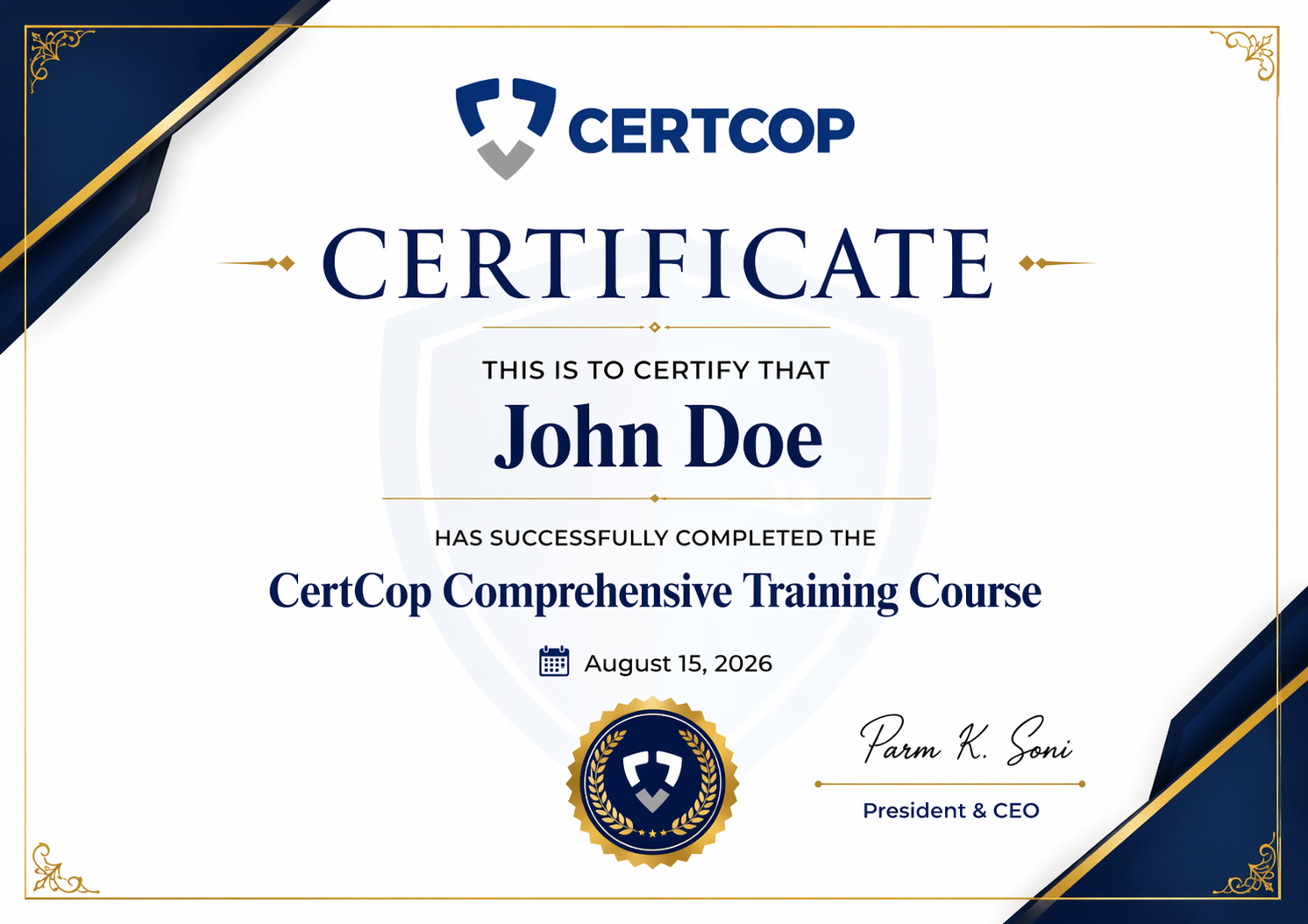
Sample certificate
Training Options
Whether you’re looking for in-classroom or live online training, CertCop offers best-in-class instructor-led training for both individuals and teams. You can also find training among CertCop’s vast network of Authorized Training Partners.
Register Now:
Related Certifications

Blue Team Certified – Defensive Security
CertCop CertCop Blue Team Certified – Defensive Security The CertCop Blue...
Read More
Red Team Certified – Offensive Security
CertCop Red Team Certified – Offensive Security Develop skills to...
Read More