

CertCop CertCop Blue Team Certified – Defensive Security The CertCop Blue...
Read MoreCertCop - Cloud Security & FedRAMP

The Cloud Security & FedRAMP – Fourth Edition training program provides the technical cloud security knowledge and FedRAMP expertise required by Cloud Service Providers (CSPs), federal agencies, assessors, compliance professionals, security teams, and other stakeholders involved in securing and authorizing cloud services for U.S. government use. The course covers cloud architecture, shared responsibility, Zero Trust, IAM, encryption, network and cloud-native security, along with key federal cybersecurity frameworks such as FISMA, FIPS 199, FIPS 200, NIST RMF, NIST SP 800-53 Revision 5, NIST SP 800-37, NIST SP 800-171, and the FedRAMP Authorization Act. It also explains the complete FedRAMP certification and authorization lifecycle, including readiness, control implementation, 3PAO assessment, documentation, risk acceptance, Marketplace listing, authorization reuse, vulnerability management, and continuous monitoring, while introducing modern practices such as FedRAMP 20x, CR26, Key Security Indicators (KSIs), OSCAL, machine-readable evidence, compliance automation, and continuous risk-based certification. Practical security implementation across AWS, Microsoft Azure, and Google Cloud further prepares learners to support real-world cloud security, compliance, assessment, and ongoing authorization activities.

Level: Intermediate to Advanced
Duration: 5 Days (Instructor-Led)
Exam: 90 Multiple Choice, 180 Minutes 70%
Course Overview
The CertCCop- Cloud Security & FedRAMP course provides comprehensive training in cloud security, federal cybersecurity requirements, and the FedRAMP certification lifecycle. It covers core cloud concepts, service and deployment models, shared responsibility, Zero Trust, IAM, MFA, encryption, key management, logging, monitoring, threat modeling, and cloud-native security, while also introducing major federal frameworks such as FISMA, FIPS 199, FIPS 200, NIST RMF, NIST SP 800-53 Rev. 5, NIST SP 800-37, and NIST SP 800-171.
The course explains the complete FedRAMP process, including the roles of Cloud Service Providers, 3PAOs, federal agencies, Authorizing Officials, the FedRAMP PMO, and the FedRAMP Board. Learners study authorization reuse, security control implementation, independent assessments, Marketplace listing, continuous monitoring, vulnerability management, remediation, and key authorization documents such as the SSP, SAP, SAR, and POA&M.
This also includes updated coverage of FedRAMP 20x, CR26, Key Security Indicators, OSCAL, machine-readable security evidence, compliance automation, and continuous certification, along with practical cloud security implementation across AWS, Microsoft Azure, and Google Cloud. The program is designed to prepare learners for both the CertCop Cloud Security & FedRAMP certification exam and real-world cloud security and federal compliance responsibilities.
Corporate Training
CertCop offers tailored group training programs designed for organizations, teams, and institutions aiming to build strong cybersecurity capabilities at scale. Our corporate training solutions focus on real-world skills, hands-on learning, and certification readiness, helping teams stay ahead of evolving threats and technologies. With flexible delivery options—including virtual, on-site, and customized programs—we ensure training aligns with your business goals, technical requirements, and workforce development needs.
Training Options
Whether you’re looking for in-classroom or live online training, CertCop offers best-in-class instructor-led training for both individuals and teams. You can also find training among CertCop’s vast network of Authorized Training Partners.
On-Demand Training
Virtual Live Training
Class Room Training
Hybrid Training
Group Training
Learning Path
Cloud Computing
Cloud Architecture
Cloud Security Fundamentals
Identity & Access Management
Data Security
Network Security
Cloud-Native Security
AWS Security
Microsoft Azure Security
Google Cloud Security
Federal Cybersecurity Framework
FedRAMP Fundamentals
FedRAMP Security Controls
FedRAMP Authorization Process
FedRAMP Documentation
FedRAMP Assessment
FedRAMP 20x
Continuous Monitoring
OSCAL & Automation
Incident Response
Governance, Risk & Compliance
FedRAMP Fundamentals
FedRAMP Security Controls
FedRAMP Authorization Process
FedRAMP Documentation
FedRAMP Assessment
FedRAMP 20x
Continuous Monitoring
OSCAL & Automation
Incident Response
Governance, Risk & Compliance
Key Skills You Will Gain
- Cloud Computing & Architecture – Understand cloud service models, deployment models, virtualization, scalability, and secure cloud architecture design.
- Cloud Security Fundamentals – Learn essential principles for protecting cloud applications, infrastructure, identities, and data.
- Identity & Access Management (IAM) – Manage users, roles, permissions, authentication, authorization, and least-privilege access.
- Zero Trust Security – Apply continuous verification and least-privilege principles without automatically trusting users, devices, or networks.
- Data Protection & Encryption – Protect sensitive data at rest and in transit using encryption, classification, and secure key management.
- Network & Cloud-Native Security – Secure cloud networks, containers, Kubernetes, APIs, microservices, and modern cloud-native workloads.
- FedRAMP Fundamentals & Governance – Understand FedRAMP objectives, governance structure, stakeholders, responsibilities, and certification lifecycle.
- NIST SP 800-53 Security Controls – Understand and apply federal security and privacy control requirements used within FedRAMP environments.
- FedRAMP Authorization & Assessment – Learn how cloud services progress through readiness, assessment, authorization, certification, and ongoing monitoring.
- SSP, SAP, SAR & POA&M Documentation – Understand the major documents used to describe, assess, report, and remediate FedRAMP security requirements.
- Continuous Monitoring & Vulnerability Management – Continuously identify vulnerabilities, track remediation, monitor changes, and maintain security posture.
- FedRAMP 20x & CR26 – Understand the modernized FedRAMP approach focused on faster, risk-based, automated, and continuous certification.
- OSCAL & Compliance Automation – Use machine-readable security information to automate documentation, assessment, validation, and compliance activities.
- Key Security Indicators (KSIs) – Understand measurable, evidence-backed security outcomes used to support FedRAMP 20x continuous certification.
- AWS Cloud Security – Apply identity, monitoring, governance, encryption, and security controls within Amazon Web Services.
- Microsoft Azure Security – Secure Azure environments using identity, posture management, monitoring, governance, and compliance capabilities.
- Google Cloud Security – Apply IAM, encryption, logging, security monitoring, governance, and compliance controls within Google Cloud.
- Incident Response & Security Operations – Detect, analyze, contain, remediate, recover from, and document security incidents in cloud environments.
- Governance, Risk & Compliance (GRC) – Manage security governance, organizational risks, regulatory requirements, controls, and accountability.
- Audit Readiness & Continuous Compliance – Maintain current documentation and evidence so security and compliance can be demonstrated whenever required.
Career Outcomes
- Cloud Security Engineer – Design, implement, and maintain security controls across modern cloud environments.
- Cloud Security Analyst – Monitor cloud infrastructure, investigate threats, manage vulnerabilities, and support security operations.
- FedRAMP Specialist – Support organizations through FedRAMP preparation, assessment, certification, authorization, and continuous monitoring.
- FedRAMP Compliance Analyst – Maintain security documentation, evidence, POA&Ms, controls, and ongoing compliance requirements.
- Cloud GRC Analyst – Manage governance, risk, compliance, policies, controls, and audit-readiness activities.
- Cloud Security Architect – Design secure cloud architectures using Zero Trust, IAM, encryption, network security, and shared-responsibility principles.
- Security Assessment Specialist – Support control testing, evidence validation, security assessments, and 3PAO-related assessment activities.
- IAM Security Specialist – Implement identity governance, authentication, MFA, privileged access, and least-privilege controls.
- Cloud Compliance Automation Specialist – Use OSCAL, machine-readable evidence, KSIs, and automation to improve continuous compliance.
- Security Operations Analyst – Perform cloud monitoring, threat detection, vulnerability management, incident investigation, and remediation.
- Incident Response Analyst – Detect, contain, investigate, recover from, and document security incidents affecting cloud environments.
- AWS Security Engineer – Implement security, identity, logging, monitoring, encryption, and compliance controls within AWS.
- Azure Security Engineer – Protect Microsoft Azure environments using identity, security monitoring, governance, and compliance capabilities.
- Google Cloud Security Engineer – Secure Google Cloud environments using IAM, encryption, monitoring, policy enforcement, and governance.
- Federal Cloud Security Consultant – Help Cloud Service Providers and federal organizations implement and maintain secure, compliant cloud services.
Exam Details
| Course Name | Certified CyberCop – FRCS |
| Course Number: | FRCS-CertCop-003 |
| Required exam | FRCS-CertCop-003 |
| Number of Questions | Maximum of 100 questions |
| Type of Questions | Multiple-choice and Scenario-based |
| Length of Test | 180 Minutes |
| Passing Score | 70% – This test has no scaled score; it’s pass/fail only. |
| Retirement | Usually three years after launch |
| Languages | English |
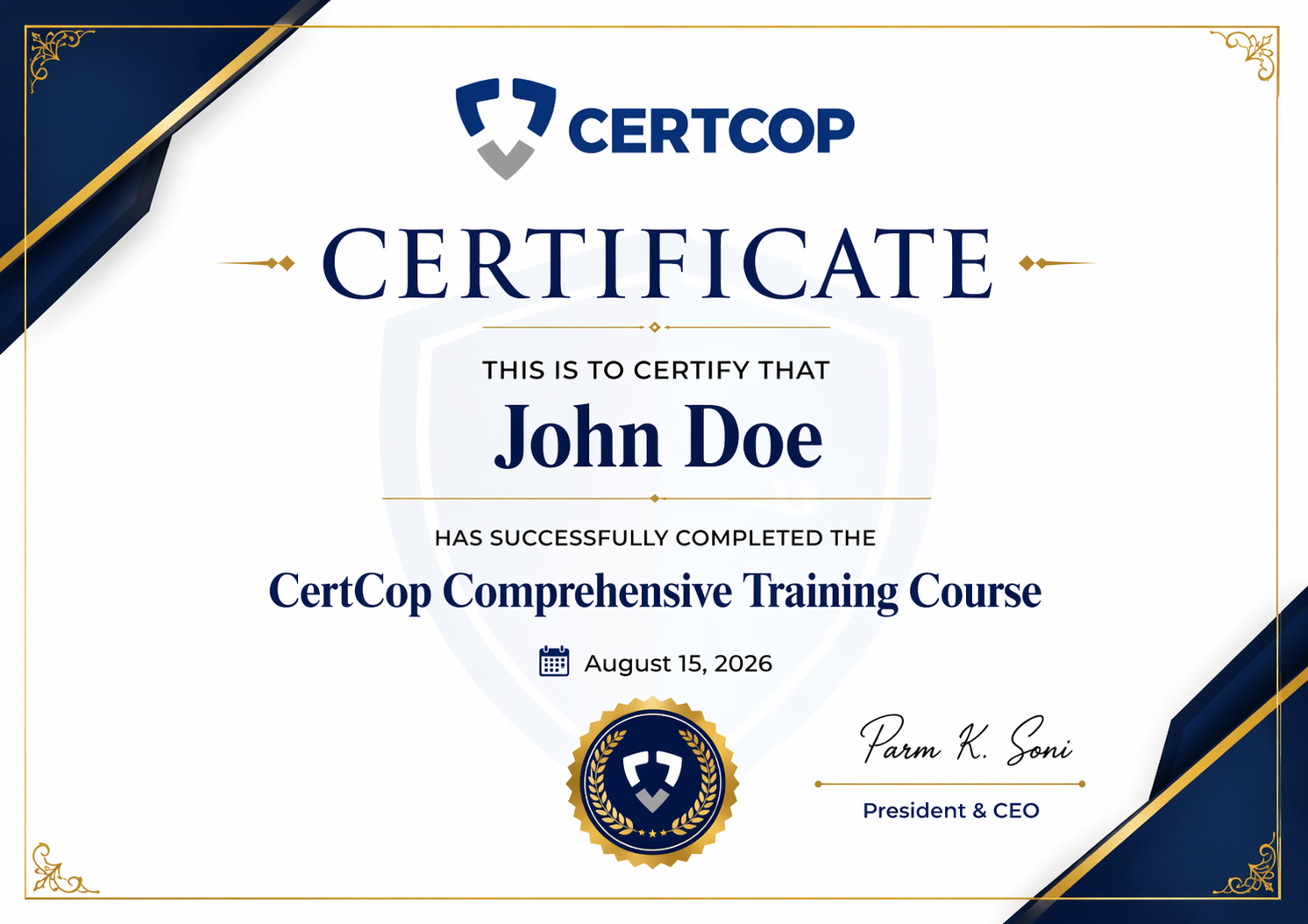
Sample certificate
Training Options
Whether you’re looking for in-classroom or live online training, CertCop offers best-in-class instructor-led training for both individuals and teams. You can also find training among CertCop’s vast network of Authorized Training Partners.
Register Now:
Related Certifications

CertCop – Cloud Security
CertCop – Cloud Security The CertCop – Cloud Security program is designed...
Read More
Red Team Certified – Offensive Security
CertCop Red Team Certified – Offensive Security Develop skills to...
Read More