Why Every CISO Must Become AI-Ready: The New Era of Cybersecurity Leadership
Yesterday’s CISO protected infrastructure. Today’s CISO must protect the organization from intelligent systems, AI risks, adversarial threats, governance failures, and organizational transformation. — CertAdvisor by Parm Soni
If you feel like the ground beneath your feet is shifting, it’s because the operational realities of our role have fundamentally altered.
Not long ago, cybersecurity leaders could comfortably relegate emerging technology discussions to enterprise architects, innovation labs, or the digital transformation office. If an artificial intelligence project was in a pilot phase, it sat safely outside the immediate risk profile of the Security Operations Center (SOC).
That luxury has expired.
Artificial intelligence has aggressively transitioned from an experimental line item to the literal nervous system of modern business operations. It is no longer just a tool; it is driving automated software development pipelines, executing live financial fraud detection, managing customer-facing decision engines, and shaping high-stakes corporate strategy.
The debate over whether your organization should adopt AI is over. It is already happening, sometimes through sanctioned corporate initiatives, but more often through “Shadow AI” applications your employees are quietly using to hit their quarterly targets. The tactical question facing leadership today is no longer about how fast the business can innovate, but whether you are equipped to govern that innovation, or if you will be left reacting to the systemic fallout after an unmanaged crisis hits the headlines.
To maintain organizational resilience in this new era, your executive perspective must shift entirely from traditional asset protection to high-level intelligent system oversight:
The New Room: What Boards Actually Care About Now
The days of walking into a board meeting with a few standard slide decks on firewall metrics, patch compliance, and vulnerability counts are drawing to a close. While fundamental infrastructure security remains non-negotiable, board members, risk committees, and executive directors have evolved their focus. They are looking at the broader macroeconomic landscape and demanding strategic risk translation.
The boardroom mandate has dramatically shifted from “protect our infrastructure” to “help us securely navigate an AI-driven business transformation.” This shift is driven by severe internal and external operational pressures that balance corporate anxiety against real-world market liabilities:
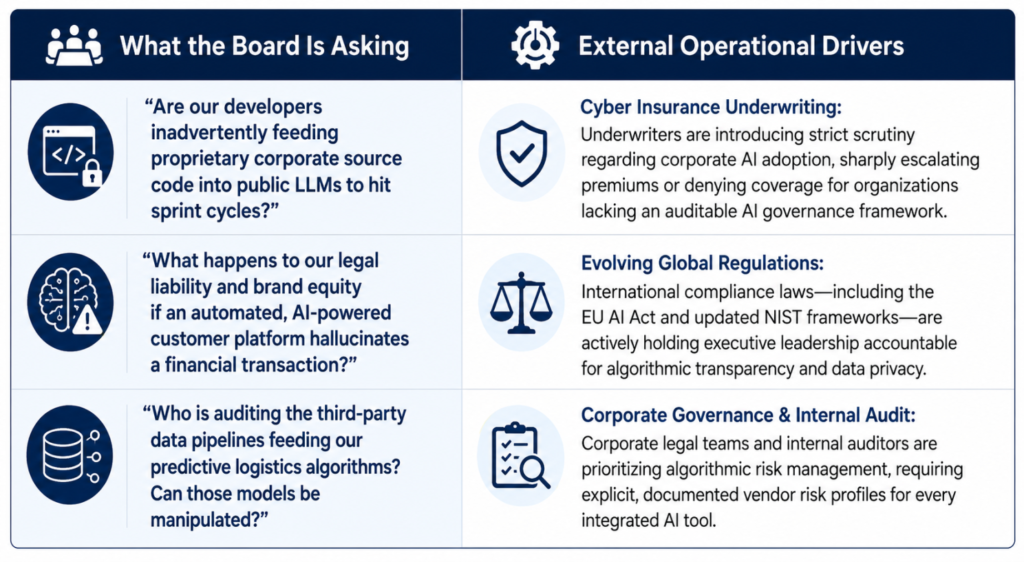
If you cannot speak this strategic, cross-functional risk language, you risk becoming isolated from the critical executive conversations that dictate corporate budgets and organizational direction. In the modern enterprise, visibility directly equals corporate influence.
From the Field: Modern Intrusion Vectors & Failure Modes
Traditional signature-based perimeters and legacy security architectures are completely blind to intelligent exploits. Sophisticated threat actors are no longer just scanning for software bugs or missing patches; they are directly exploiting the logic, the mathematical data inputs, and the trust models of intelligent systems
These adversarial vectors are not theoretical concepts—they are manifesting as real-world enterprise failure modes on the ground right now:
- 1. The Synthetic Identity Trap (Deepfake Exploits): A Tier-1 financial institution recently faced a highly coordinated attack where adversaries did not exploit a traditional software vulnerability; instead, they targeted human trust. Using sophisticated deepfake voice cloning, they perfectly replicated an executive’s voice during an urgent call, successfully convincing teams to authorize a multi-million dollar third-party wire transfer. Legacy identity verification protocols are entirely inadequate against this threat.
- 2. The Model Poisoning Vulnerability (Data Integrity): Consider a global logistics provider relying heavily on a complex predictive AI engine to manage international supply chains and inventory allocations. If malicious actors find a way to manipulate the upstream training data inputs, they can subtly skew the model’s outputs. The result is a series of artificial disruptions to distribution channels that look like normal market fluctuations but cost millions in operational efficiency.
- 3. The LLM Data Leakage (Governance Failure): A healthcare provider integrated a generative AI platform to assist clinicians with summarizing patient triage notes. Because a robust data-isolation governance framework was not established prior to deployment, sensitive, regulated patient metrics were inadvertently absorbed into a broader public vendor training set, triggering an immediate regulatory and compliance crisis.
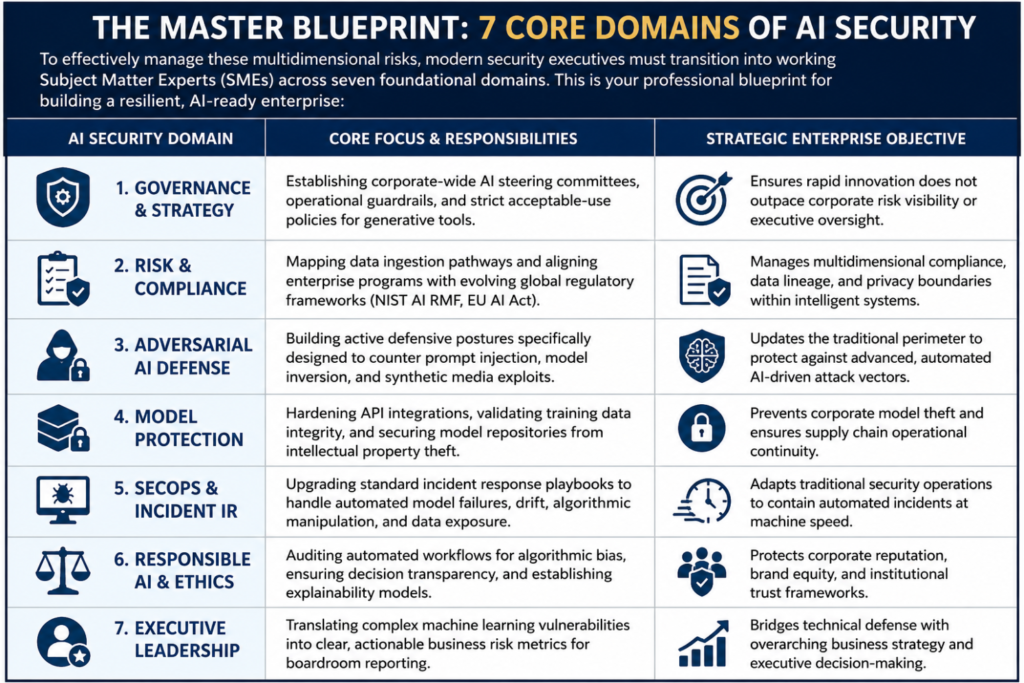
The Master Blueprint: 7 Core Domains of AI Security
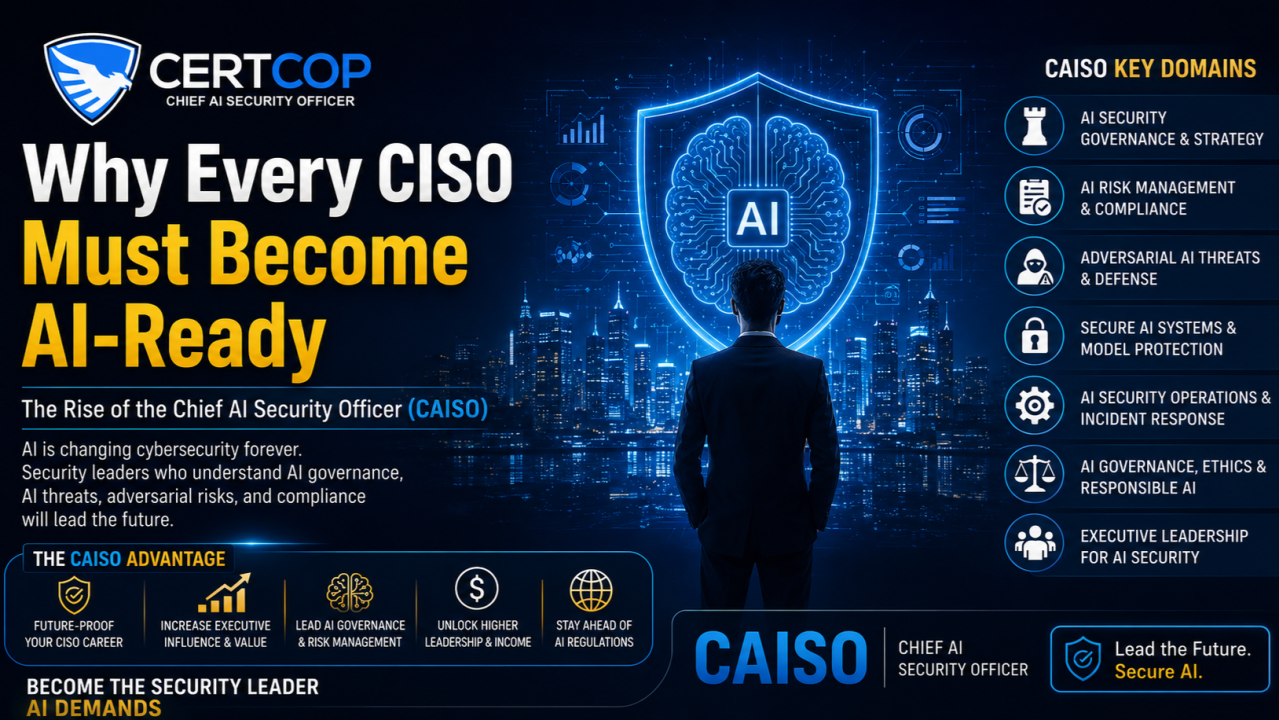
To effectively manage these multidimensional risks, modern security executives must transition into working Subject Matter Experts (SMEs) across seven foundational domains. This is your professional blueprint for building a resilient, AI-ready enterprise:
The Strategic Path: Earning the CAISO Credential
Navigating this technological pivot successfully does not require you to become a machine learning engineer or a data scientist. Your responsibility as a senior security leader is not to write code—it is to be an informed, authoritative decision-maker.
To bridge this critical industry capability gap, CertCop established the Chief AI Security Officer (CAISO) certification program. Engineered explicitly as an executive-first validation, the CAISO pathway synthesizes technical, regulatory, and operational domains into a unified framework for modern corporate resilience.
Why the CAISO Validation Is Vital for Modern Executives:
- Immediate Strategic Differentiation: As enterprises globally integrate machine learning architectures, the market demand for certified executives who understand the dual nature of AI opportunity and exposure is accelerating. This credential demonstrates that you are equipped to secure the future of intelligent business.
- Executive-Level Focus: The curriculum deliberately bypasses low-level coding bootcamp models to focus exclusively on what corporate leaders must master: vendor vetting, programmatic accountability, liability management, and cross-functional collaboration across Legal, HR, and Operations.
- Flexible Executive Delivery: Engineered to fit the demanding schedules of practicing professionals, CertCop delivers this curriculum via high-impact Virtual Instructor-Led Training (VILT) with global enterprise experts, alongside comprehensive, structured On-Demand Self-Study modules.
Your Next Strategic Move
The future of cybersecurity leadership will not be defined by mastering a single AI tool, it will be defined by understanding how AI transforms enterprise risk, governance, compliance, and security at scale. The Chief AI Security Officer (CAISO) program from CertCop is designed to help cybersecurity leaders build practical expertise in securing, governing, and leading AI transformation across the enterprise. Available through CertCop / CertFirst via On-Demand Self-Study and Virtual Live Instructor-Led Training (VILT), the CAISO pathway helps professionals strengthen their understanding of:
- AI security governance
- Adversarial AI threats
- Enterprise AI risk management
- Compliance and regulatory implications
- Responsible AI frameworks
- Executive leadership for AI security
Ask yourself this:
In the next five years, will organizations value professionals who only know how to use one AI tool — or leaders who understand how to securely govern, manage, and protect AI across the enterprise?
Not sure where to begin?
Comment “CAISO Path” and I’ll help map a personalized AI security leadership pathway aligned with your cybersecurity career goals and executive aspirations.
A Final Perspective: Securing What We Are Becoming
Cybersecurity leadership is standing at a defining historical crossroads. Every major technological inflection point creates a divide between executives who adapt early to shape the landscape and those who continue to rely on yesterday’s assumptions.
The organizations that navigate this era successfully will not be the ones moving the fastest or deploying models recklessly without guardrails. The future belongs to organizations that move responsibly, building robust frameworks that balance rapid innovation with absolute security, compliance, and institutional trust.
Cybersecurity leadership is no longer only about defending the infrastructure your organization built yesterday. It is about securing what your organization is becoming tomorrow.
Take control of the narrative, protect your enterprise, and solidify your position at the strategic corporate table.
“Yesterday’s CISO protected systems. Tomorrow’s CISO must protect intelligent systems, enterprise trust, and the future of AI-driven business.” — Parm Soni

Previous post