The 2026 Workforce Mandate: Navigating AI, Cybersecurity, and Vendor-Neutral Certifications By Parm Soni, CertAdvisor™
From the 1990s to 2026: A Full-Circle Transformation
In the early 1990s, when I first entered the technology industry, the landscape was fundamentally different from what we see today. At that time, a “network” often meant a group of systems running Novell NetWare, and earning a certification such as the Certified Novell Engineer (CNE) was a defining milestone. It wasn’t just another credential; it was your entry point into the IT profession and, in many cases, your gateway to opportunity.
As the industry matured, I witnessed the rapid rise of Microsoft certifications, followed by the dominance of Cisco, Oracle, and other major vendors. Certifications in that era were tightly aligned with specific platforms. Professionals built their careers within those ecosystems, Microsoft professionals stayed in Microsoft environments, Cisco engineers built networking careers, and specialization was the key to growth.
Back then, certifications served one primary purpose: They validated your technical capability.
What Changed: From Validation to Survival
Fast forward to 2026, and we are witnessing a transformation that rivals, if not surpasses, the early days of enterprise computing.
The difference is not just technological; it is fundamental.
- In the 1990s, certifications helped you enter the industry
- In 2026, certifications will determine whether you can stay in the industry
This is no longer about gaining an advantage; it is about maintaining relevance.
Artificial Intelligence, cybersecurity, and emerging technologies have reshaped expectations across every role. What was once considered specialization is now becoming baseline knowledge.
Certifications are no longer optional. They are becoming a requirement for employability.
The New Reality: AI, Cybersecurity, and Emerging Technologies
The modern workforce operates in an entirely different environment—one defined by constant change, interconnected systems, and accelerated innovation.
We are no longer working in isolated domains. Instead, we are part of an ecosystem where:
- AI is embedded into nearly every role, from data analysis to customer support, AI is driving automation, insights, and decision-making.
- Cybersecurity is no longer a niche; it is universal. Every system, every application, and every organization must operate with security as a foundational requirement.
- Emerging technologies are evolving faster than traditional learning models By the time a skill is learned, it may already be evolving into something new.
This creates a new kind of professional expectation:
You are no longer defined by what you know, you are defined by how quickly you can adapt.
The Shift Toward Vendor-Neutral Thinking
One of the most important changes in the certification landscape is the move away from vendor-specific expertise toward vendor-neutral mastery.
In the past, mastering a single platform was enough.
Today, organizations operate in:
- Multi-cloud environments
- Hybrid infrastructures
- Rapidly shifting technology stacks
This means employers are no longer looking for someone who knows just one tool—they are looking for professionals who understand principles, architectures, and integration across systems.
The focus has shifted from: “What platform do you know?” → “How well do you understand the ecosystem?”
Vendor-neutral certifications have become critical because they:
- Provide flexibility across environments
- Reduce dependency on a single technology
- Enable professionals to adapt quickly
AI + Cyber + Cloud: The Convergence That Defines Careers
Another defining characteristic of today’s workforce is convergence.
AI, cybersecurity, and cloud are no longer separate domains, they are interconnected.
For example:
- AI models run on cloud infrastructure
- Cloud environments must be secured against AI-driven threats
- Cybersecurity teams now use AI for detection and response
This convergence is reshaping job roles:
- A security analyst must understand AI-based threats
- A data professional must understand security and governance
- A cloud engineer must integrate automation and intelligence
The modern professional is no longer a specialist in isolation, but a hybrid expert across domains.
Certifications That Matter in 2026
To navigate this landscape, professionals must focus on certifications that align with real-world demands.
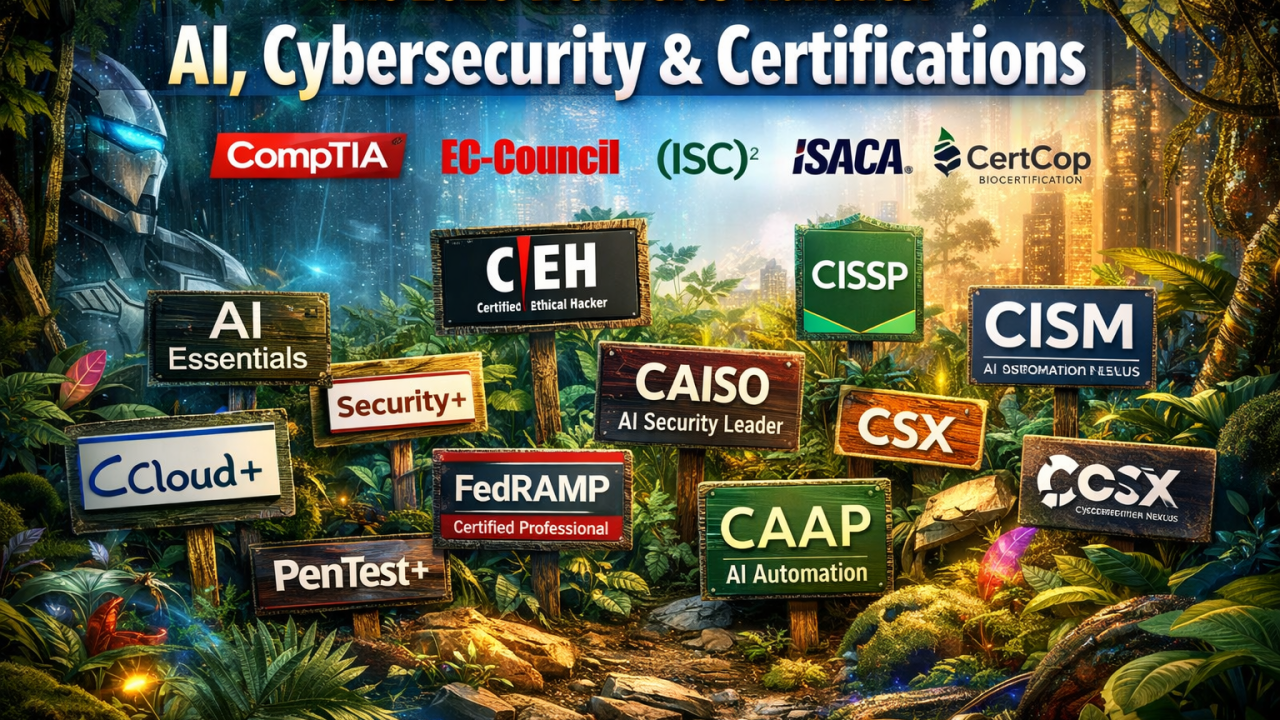
Three major players are shaping this ecosystem:
- CompTIA → Foundation and integration
- CertCop → Specialization and emerging technologies
- EC-Council → Security and offensive AI
Each serves a different purpose:
- CompTIA builds the base and ensures you understand how systems connect
- CertCop helps you specialize in high-demand, niche areas
- EC-Council strengthens your ability to defend and secure modern systems
The smartest approach is not choosing one—but combining them strategically.
The Economic Reality: Skills That Pay
The market has already started reflecting these changes.
Salary trends clearly show that professionals with:
- AI knowledge
- Cybersecurity expertise
- Vendor-neutral certifications
are commanding higher value.
Typical ranges:
- Entry-level AI-enabled roles → $60K – $85K
- Mid-level hybrid professionals → $90K – $150K
- Advanced / leadership roles → $150K – $250K+
But beyond salary, the real advantage is career longevity.
A Practical Perspective from Experience
Having spent over three decades in this industry, from the Novell era to today’s AI-driven world, I’ve seen cycles of transformation.
Technologies change. Vendors change. Platforms evolve.
But one thing remains constant:
Those who adapt survive. Those who don’t, fall behind.
In the 1990s, those who learned networking thrived. In the 2000s, those who adopted cloud stayed relevant. In 2026, those who embrace AI and cybersecurity will define the future.
Time to Make IT… or Break IT
We have reached a defining moment.
The importance of AI, cybersecurity, and emerging technology certifications today is equivalent to, if not greater than, the importance of networking certifications in the 1990s.
But the stakes are higher.
This is no longer about getting ahead. This is about not falling behind.
Final Thought
The future workforce will not be defined by titles—it will be defined by capability.
- Build your foundation
- Expand into AI and cybersecurity
- Stay vendor-neutral
- Keep learning
Because in today’s world:
AI is not replacing professionals, It is replacing those who refuse to evolve.